

Osteoarthritis as an occupational hazard: the physical side of working as a Pro Domme
In this article
- A physical profession, although we rarely call it that
- Those gorgeous boots do come at a price
- Osteoarthritis is more than a bit of wear and tear
- The moment your body no longer cooperates as a matter of course
- Perhaps those heels don't need to stay on for three hours
- Keeping moving is actually important
- The work does not have to stop when your body changes
Anyone who has worked as a professional Mistress for years knows that the profession is far more physically demanding than outsiders probably suspect. In a photo, people see the high boots, the corset, the whip and a Lady who seemingly commands the room without effort. What you don't see in that photo are the hours she spends on her feet, the strength she draws from her shoulders and back, and the sometimes rather awkward positions she ends up in simply because her sub happens to be tied down right there.
A good session can be quite physically intensive. Especially when you have been doing this work for years, several times a week. Knees, hips, ankles, back, shoulders, elbows and hands have a lot to endure. Someone who barely notices any of this at a younger age may suddenly discover years later that the body has in fact been keeping the books all along.
A physical profession, although we rarely call it that
Within our profession we talk a lot about mental strain. About guarding boundaries, carrying responsibility, staying alert and constantly being able to anticipate the needs of the person entrusted to our care. We talk much less about the physical strain. Yet it is just as much a part of the job.
Just think of impact play. Handling a flogger, cane or whip may seem simple, but anyone who strikes with control and precision for an extended period is constantly using the same muscles and joints. Depending on the instrument, the movement comes from the fingers, wrist, elbow or shoulder, and sometimes from a combination of these. On top of that, you often stand in the same position for a long time while doing it.
Bondage involves a different kind of strain. Bending, kneeling, working around someone, applying force, pulling rope tight and then getting back up again. With medical play, working bent forward for long periods can be a strain. With immobilisation, you sometimes spend minutes carefully getting someone into position. Even something seemingly simple, like putting on high-heeled boots and then walking around in them for a few hours, asks something of your body.
Those gorgeous boots do come at a price
For many Pro Dommes, extremely high heels are part of the image they project. They change your posture, the way you walk and sometimes even how you feel when you enter a room. That does not mean high heels automatically cause osteoarthritis. The scientific evidence for that is not convincing enough.
High heels do, however, change the biomechanics of standing and walking. When you combine that with hours of standing, turning, bending and applying force, it is hardly surprising if your knees, feet, ankles or back start to protest at some point.
There is also a pitfall here. In our world, after all, pain belongs to the person lying in front of us. We are the one standing upright. We are in control. Sitting down on a chair for a moment because your knee, hip or ankle hurts may not fit the image you have built of yourself as a Mistress. Until your body decides it has no say in the matter.
Osteoarthritis is more than a bit of wear and tear
Osteoarthritis is commonly called wear and tear, but that actually does the condition an injustice. With osteoarthritis the entire joint changes. The cartilage becomes thinner and less smooth, and the bone can also change over time. Pain and stiffness are familiar complaints, and a joint can eventually become less mobile.
There is no single cause. Age plays a role, hereditary predisposition can contribute, previous injury to a joint increases the risk, and body weight can also have an influence on certain joints. In addition, we know that years of heavy physical strain can be a risk factor for certain forms of osteoarthritis.
This does not mean you can claim that the profession of Pro Domme causes osteoarthritis. As far as we know, no specific research has been done on that. But our work certainly involves forms of physical strain that are also described in research into other professions. And that makes it worth thinking about within our professional group.
The moment your body no longer cooperates as a matter of course
The annoying thing about osteoarthritis is that it does not necessarily start overnight. At first there may only be some stiffness when you get up. A knee that aches after a long day. A shoulder that lets you know the next morning that the extended impact session was a bit more intensive than you thought.
Without noticing, you adapt: you switch hands a little more often, stand differently, avoid a certain movement, and put on those gorgeous boots only just before the appointment instead of walking around in them for an hour beforehand. That can go perfectly well for a long time.
But when pain, stiffness and limited movement increase, the work can become more and more complicated. Not only because something hurts, but also because physical reliability is part of safety. If you tie someone up, place needles, deliver impact or work physically with someone in any other way, you need to be able to trust that your own body will do what you expect of it.
That makes physical complaints in our profession not just a personal problem. Ultimately, they also affect your ability to work responsibly.
Perhaps those heels don't need to stay on for three hours
As far as we are concerned, working professionally also means thinking about how you want to still be able to do this work in ten or twenty years' time. That does not have to mean we should all walk through the dungeon in ergonomic trainers from now on (incidentally, my combat boots suit me just fine). But we can treat our bodies more wisely.
Those twenty-centimetre boots can be fantastic for the welcome, during certain parts of a session and of course for photography. That does not automatically mean you have to keep standing in them for three hours straight. A good, sturdy boot with a lower heel can be a more sensible alternative during physical work.
The same goes for the layout of a playroom. You may not notice a workbench at the wrong height during a single session, but after hundreds of sessions that is a different story. A sturdy chair or throne is not just decoration. Working heights, sufficient room to move and the possibility to change position are just as relevant in a dungeon as in any other professional working environment.
Perhaps we should even let go of the idea that a Mistress must always be the one doing the heaviest physical work. A sub can take up a position themselves. A slave can hand over materials, tidy up, hold something or move on instruction. Psychological dominance, moreover, costs your knees next to nothing and can be at least as intense as half an hour with a flogger. Ultimately, dominance does not lie in how much physical labour you do yourself.
Keeping moving is actually important
When joints start to hurt, moving less seems the obvious choice. With osteoarthritis, however, sparing the joints entirely is usually not the idea. Exercise and movement help keep muscles stronger. Strong muscles support the joints and can help keep movement easier.
Walking, cycling and swimming are examples of activities that are often recommended. Targeted exercises, possibly together with a physiotherapist or exercise therapist, can also help.
For a Pro Domme, it can be worth taking this one step further. Not just training because you have complaints, but maintaining your body because it is part of your work. If you know you work a lot with floggers, you can pay attention to your shoulders, arms and core. If you stand, kneel and have to get back up a lot during sessions, you benefit from strong legs and sufficient mobility.
After all, we also maintain our whips, furniture and equipment. Why would we be less careful with the most important instrument in the dungeon?
The work does not have to stop when your body changes
Perhaps that is ultimately the most important point. An ageing body, or one that can take less strain, does not automatically mean the end of a career as a Pro Domme. It may, however, mean that the way you work changes.
Less brute physical labour and more direction. No longer standing for three hours when part of a session can just as well be done seated. Positioning a sub differently so that you don't have to work bent forward for twenty minutes. Replacing heavy materials with alternatives. Scheduling more recovery time between appointments. And sometimes accepting that a certain action is no longer wise.
That is not a loss of dominance. Quite the contrary. There is little mastery in physically wearing yourself out because you believe a Mistress must always stand on towering heels and do everything with her own hands. Anyone who wants to keep practising this profession for a long time will not only have to treat her sub's body with care. She will have to treat her own body with at least as much care.
Because that body still has a good many years to go.
Mrs Moriah
Deze pagina is ook beschikbaar in het Nederlands →
Read also
Connection within BDSM: the foundation you build on
Within BDSM we talk a lot about trust, boundaries, safety, techniques and responsibility. All important subjects. But there is something that, for…
9 September 2026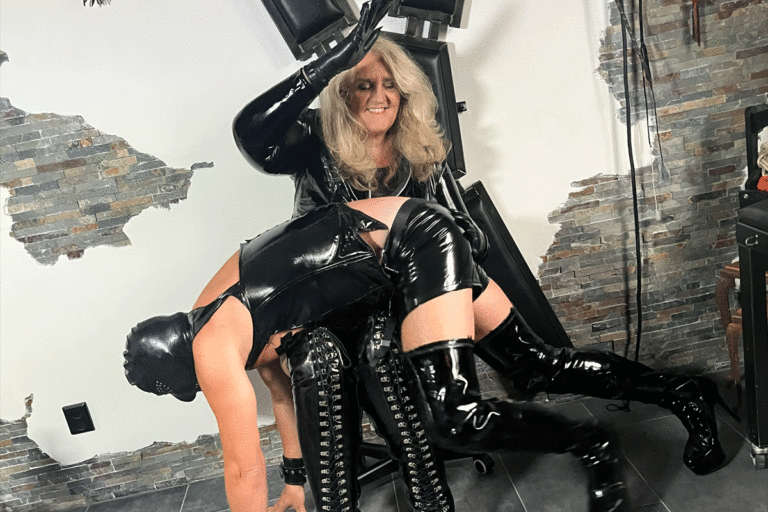
Recognisable client types in the work of a Pro Domme
Recognisable client types in the work of a Pro Domme. Anyone who works as a Pro Domme for a longer period discovers that no two clients are the same…
28 August 2026
Press release: 16 August 2026
Pro Domme Society: a new network in which dominant women strengthen one another The world of BDSM is diverse. Behind every Mistress lies her own…
16 August 2026